Kitchen appliances have quietly transformed how people cook over the last decade, and few categories illustrate that shift better than the multifunction electric pressure cooker. What used to require a stovetop pressure cooker, a separate rice cooker, a slow cooker, and a steamer basket can now, in many households, be handled by a single countertop unit. This article takes a closer look at one such appliance: an 8-quart stainless steel pressure cooker that combines 14 cooking functions, a 24-hour presetting timer, an LED display, and a nonstick removable pot. Whether you’re outfitting a first apartment, replacing an aging appliance, or simply curious about what these all-in-one cookers actually do, this guide walks through the practical details.
Introduction
Multi-function cookers have become a staple in many kitchens because they solve a fairly universal problem: limited counter space and limited time. Instead of owning three or four single-purpose appliances, a combination unit like this one aims to consolidate pressure cooking, slow cooking, rice cooking, steaming, and food warming into a single stainless steel pot. The 8-quart capacity places it on the larger end of the home-use spectrum, which tends to make it a relevant option for bigger households, batch cooking, or anyone who likes having leftovers on hand.
This particular model pairs its cooking functions with a digital LED interface and a 24-hour delay-start timer, features that are increasingly common in this appliance category but still worth understanding in detail before deciding whether they fit your routine. Below, we’ll break down what the unit offers, how it might be used in a real kitchen, who tends to benefit most from this type of appliance, and what to weigh before adding one to your countertop.
Key Features
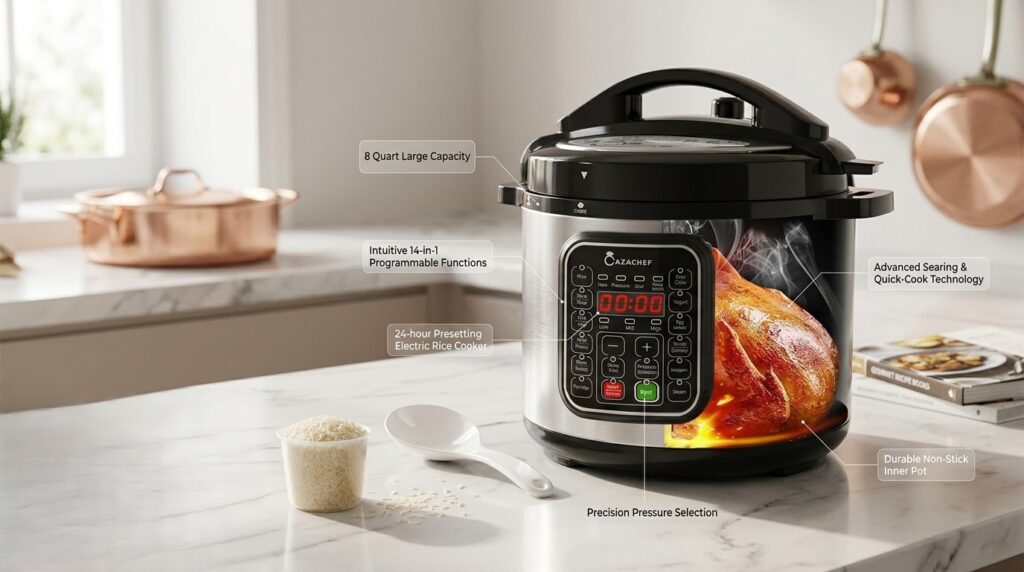
8-Quart Stainless Steel Construction
The cooking pot and outer components are built around stainless steel, a material widely chosen in kitchen appliances for its resistance to corrosion, its durability under repeated heating and cooling cycles, and the fact that it doesn’t retain odors the way some plastics can over time. An 8-quart capacity is generally enough to prepare a whole chicken, a large pot of soup, or a big batch of rice for meal prepping across several days. Households of four or more, or anyone who cooks in bulk, often find that this size reduces the need to cook in multiple batches.
14-in-1 Functionality
The “14-in-1” designation refers to the range of cooking modes built into the appliance. While the exact list can vary slightly by model configuration, this type of unit typically includes functions such as:
- Pressure cooking
- Slow cooking
- Rice cooking
- Steaming
- Sautéing or browning
- Soup or stew making
- Yogurt making
- Warming
- Reheating
- Cake or baking mode
- Egg cooking presets
- Porridge or congee settings
- Multigrain cooking
- Sterilizing (for bottles or jars)
Having these functions consolidated into one appliance means fewer gadgets to store and, in theory, less clutter on the counter. That said, each function is only as useful as your actual cooking habits, so it’s worth thinking about which of these modes you’d realistically use on a weekly basis versus which ones might go untouched.
Temperature Control
Adjustable temperature control is a feature that separates more advanced multicookers from basic ones. Rather than relying on a single fixed heat setting for slow cooking or sautéing, temperature control allows for finer adjustments depending on the recipe. This matters particularly for slow cooking, where the difference between a low simmer and a more active bubble can affect texture, and for sautéing, where higher heat is often needed to properly brown meat or vegetables before pressure cooking begins.
24-Hour Presetting Timer
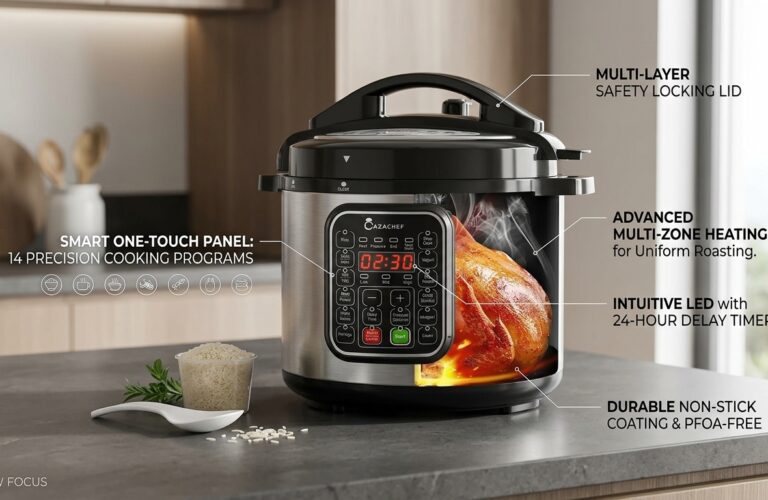
The delay-start timer is one of the more practical conveniences built into this type of cooker. In essence, it lets you load ingredients into the pot, set a start time up to 24 hours in advance, and walk away. This is commonly used for rice or oatmeal that finishes cooking right as someone wakes up, or for a stew that’s ready the moment someone gets home from work. It’s worth noting that delay-start functions are generally not recommended for highly perishable proteins sitting at room temperature for extended periods, so understanding food safety guidelines for your specific ingredients is a good idea before relying heavily on this feature.
LED Display and Digital Controls
An LED screen typically shows the selected function, remaining cook time, and temperature settings. Digital controls tend to be more precise than manual dial-based systems, and many users find them easier to read at a glance, especially in dimmer kitchen lighting.
Nonstick Removable Pot
The inner pot’s nonstick coating is designed to reduce food sticking and make cleanup less labor-intensive. Because the pot is removable, it can usually be taken out, cleaned separately, and (depending on the manufacturer’s care instructions) may be dishwasher safe. Removable pots also make it easier to serve directly from the cooker or transfer contents to another container without maneuvering the entire appliance.
Food Warmer Function
Once a dish finishes cooking, many of these units automatically shift into a keep-warm mode. This is particularly useful for gatherings, potlucks, or households where family members eat at different times, since it helps maintain food at a safe, consistent temperature without additional monitoring.
How It Can Be Used
Understanding the individual features is one thing, but seeing how they translate into everyday cooking scenarios is often more useful. Here are some practical ways a cooker like this tends to get used:
Weeknight meal prep. Because it combines sautéing and pressure cooking in one vessel, many one-pot meals — like chili, curry, or braised meats — can be started and finished without dirtying multiple pans. Browning aromatics, adding liquid, and switching to pressure mode all happen in the same pot.
Batch cooking grains and legumes. The rice cooking and multigrain settings are often used for preparing large batches of rice, quinoa, or dried beans ahead of time, which can then be portioned out across the week.
Slow-cooked dishes. For people who enjoy the low-and-slow method — think pulled pork, pot roast, or slow-simmered sauces — the slow cook function with adjustable temperature offers an alternative to a dedicated slow cooker.
Steamed vegetables and proteins. The steaming function is commonly used for vegetables, dumplings, fish, or eggs, offering a way to cook without added fats.
Homemade yogurt. Some users take advantage of the yogurt setting to culture homemade yogurt overnight, which can be a more economical option compared to store-bought varieties over time.
Overnight or delayed cooking. The 24-hour timer is often used to prep ingredients the night before and have a hot breakfast, like oatmeal or congee, ready in the morning.
Entertaining and gatherings. The keep-warm function can help hold soups, stews, or side dishes at serving temperature during parties or family events, reducing the need for reheating.
Who It May Be Suitable For
This type of appliance tends to appeal to a fairly broad range of people, though it’s not necessarily the right fit for everyone. Some general categories of users who often find multifunction cookers useful include:
Larger households or families. The 8-quart capacity is generally more appropriate for families of four or more, or for anyone who regularly cooks in bulk for the week ahead.
People with limited kitchen space. Consolidating several appliances into one unit can be helpful for smaller kitchens, apartments, or shared living situations where counter and cabinet space is limited.
Busy individuals and working professionals. The delay-start timer and keep-warm function cater well to people who want food ready around a specific schedule without needing to be present at the exact moment cooking finishes.
Home cooks exploring new techniques. For those interested in trying pressure cooking, slow cooking, or homemade yogurt without purchasing separate specialized appliances, a combination unit offers a lower-commitment way to experiment.
Meal preppers. Anyone who prepares food in advance for the week may appreciate the larger capacity and variety of functions, since it allows different types of dishes to be made in the same appliance across different days.
On the other hand, individuals who cook primarily for one person, have very specific appliance preferences (such as dedicated high-end rice cookers for specialty rice types), or have minimal storage for an 8-quart unit might want to weigh the size and functionality against their actual needs before purchasing.
Important Things to Consider
No appliance is a perfect fit for every kitchen, and it’s worth thinking through a few practical points before deciding if this cooker aligns with your needs.
Counter and Storage Space
An 8-quart unit is noticeably larger than 3- or 6-quart alternatives. Before purchasing, it’s worth measuring your available counter space and any cabinet or pantry area where you might store the appliance when not in use, since these multicookers are rarely small enough to leave permanently out of sight in a smaller kitchen.
Learning Curve
With 14 different functions, there can be a learning curve involved in understanding which settings work best for which dishes. Reading the included instruction manual thoroughly, and perhaps looking up a few beginner recipes specific to the appliance, can help shorten this adjustment period.
Maintenance and Cleaning
While the nonstick pot and removable components are generally designed for easier cleanup, it’s still worth understanding the manufacturer’s care instructions, particularly around whether parts are dishwasher-safe and how to clean the sealing ring, which can retain odors from strongly flavored dishes like curries if not cleaned regularly.
Power and Electrical Requirements
Multicookers of this size typically draw a meaningful amount of power, especially when in pressure cooking or sauté mode. Checking that your kitchen outlets can accommodate the wattage, and avoiding overloaded circuits with other high-draw appliances running simultaneously, is a reasonable precaution.
Food Safety with Delay Timers
As mentioned earlier, the 24-hour presetting feature is convenient, but it’s important to be mindful of which ingredients are safe to leave at room temperature for extended periods before cooking begins. Grains, dried legumes, and certain vegetables tend to be safer choices for delayed starts, while raw meat, dairy, and seafood generally require more caution or refrigeration-based prep methods.
Warranty and Manufacturer Support
As with any electrical kitchen appliance, checking the manufacturer’s warranty terms and understanding what kind of customer support is available can be a helpful step, particularly for a higher-use item like a multicooker that may see daily use in some households.
Comparison of General Appliance Categories
Rather than comparing specific brands, it can be more useful to understand how multifunction cookers generally stack up against single-purpose kitchen appliances, since this reflects the core trade-off many buyers are weighing.
Multifunction cookers vs. dedicated pressure cookers: A dedicated stovetop or single-purpose electric pressure cooker may offer a more focused, sometimes simpler design for pressure cooking specifically. Multifunction units trade some of that specialization for versatility, allowing one appliance to handle several cooking methods.
Multifunction cookers vs. dedicated rice cookers: Rice cookers built specifically for rice, particularly higher-end Japanese-style models, are sometimes noted for very precise rice texture control across different rice varieties. A multifunction cooker’s rice setting is generally designed to be a solid all-purpose option rather than a highly specialized one.
Multifunction cookers vs. dedicated slow cookers: Traditional slow cookers often use simpler dial-based low/medium/high settings and are built specifically for long, low-temperature cooking. A multifunction unit with adjustable temperature control can replicate much of this functionality while also offering pressure cooking and other modes, though some users who slow-cook very frequently may still prefer the simplicity of a dedicated unit.
Multifunction cookers vs. steamers: Dedicated electric steamers, often with multiple stacked tiers, can sometimes steam larger quantities of food simultaneously across different compartments. A multifunction cooker’s steaming setting is generally single-basket, which may be more limiting for very large steaming batches.
In general, the appeal of a multifunction cooker lies in consolidation and convenience rather than outperforming every dedicated single-purpose appliance in its specific category. For households that value counter space and versatility over specialized performance in any one function, this type of trade-off tends to make sense.
Frequently Asked Questions
Is an 8-quart cooker too large for a small household? It depends on cooking habits. Even smaller households that enjoy batch cooking or meal prepping for the week may find the larger capacity useful, while those who cook small portions daily might prefer a smaller unit.
Can this type of cooker replace a stovetop pressure cooker entirely? For many everyday uses, yes, though some experienced pressure cooking enthusiasts prefer stovetop models for the ability to make very rapid pressure adjustments. Electric versions generally offer more convenience and safety features, such as automatic pressure release and digital timing.
Is the nonstick coating safe for long-term use? Nonstick coatings vary by manufacturer and material. It’s generally recommended to avoid metal utensils that could scratch the coating and to follow the manufacturer’s guidance on maximum recommended temperatures to help preserve the coating’s lifespan.
How loud is the pressure release process? Pressure release on electric multicookers can be audibly noticeable, similar to a kettle reaching a boil, though this varies by model and release method (natural release versus quick release).
Does the delay-start timer work for all 14 functions? Typically, delay timers are most compatible with functions like rice cooking, slow cooking, and porridge settings, while functions like sautéing usually require the process to begin immediately. Checking the specific manual for this model is the best way to confirm which settings support delayed starts.
Is it difficult to clean the sealing ring? The sealing ring, which helps maintain pressure inside the pot, can absorb odors from strongly flavored foods. Many people find it helpful to have a second sealing ring on hand — one for savory dishes and one for sweeter or more neutral recipes — to prevent flavor transfer, though this is optional rather than necessary.
Can the inner pot go in the dishwasher? This depends on the specific model’s care instructions. Many nonstick removable pots are dishwasher-safe, but it’s worth confirming with the manufacturer’s guidelines to avoid damaging the coating over time.
Conclusion
An 8-quart, 14-in-1 multifunction electric pressure cooker represents a fairly comprehensive approach to consolidating kitchen appliances, combining pressure cooking, slow cooking, rice preparation, steaming, and food warming into a single stainless steel unit. Features like adjustable temperature control, a 24-hour delay-start timer, and an LED display reflect the broader trend toward appliances that offer both flexibility and convenience for home cooks juggling busy schedules.
Whether this particular cooker is the right choice ultimately comes down to your household size, available kitchen space, and how many of its 14 functions you’re likely to use regularly. For larger families, meal preppers, or anyone looking to simplify their kitchen setup without sacrificing cooking versatility, this category of appliance is generally worth understanding in more depth.