Kitchen appliances have quietly become smarter over the past decade, and multicookers are a good example of just how far that shift has gone. What started as a simple pressure cooker category has evolved into something far more sophisticated—devices that connect to your phone, weigh ingredients automatically, and walk you through recipes step by step. The CHEF iQ Smart Pressure Cooker with WiFi and Built-in Scale sits squarely in this new generation of kitchen technology, combining a traditional 10-in-1 multicooker function with app connectivity and an integrated scale.
This article takes a closer look at what this appliance offers, how it might fit into different types of households, and what factors are worth thinking about before adding one to your kitchen lineup. Rather than framing this as a review, the goal here is to walk through the practical realities of the product—its design, its functionality, and the kinds of cooking scenarios where it tends to make the most sense.
What Is the CHEF iQ Smart Pressure Cooker?
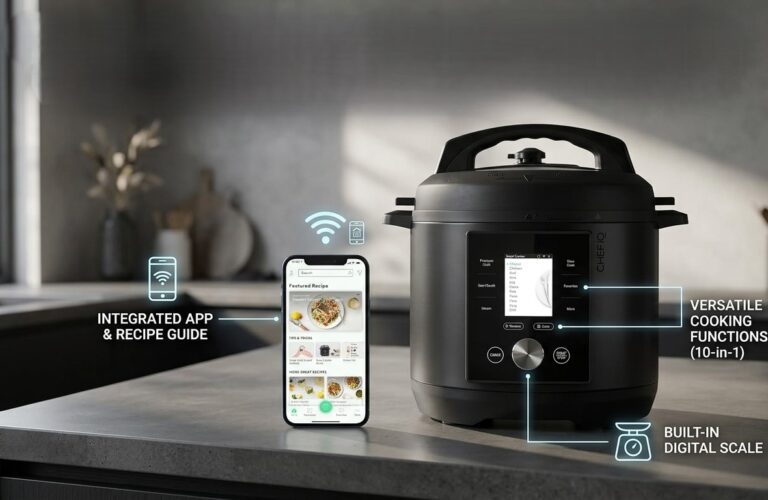
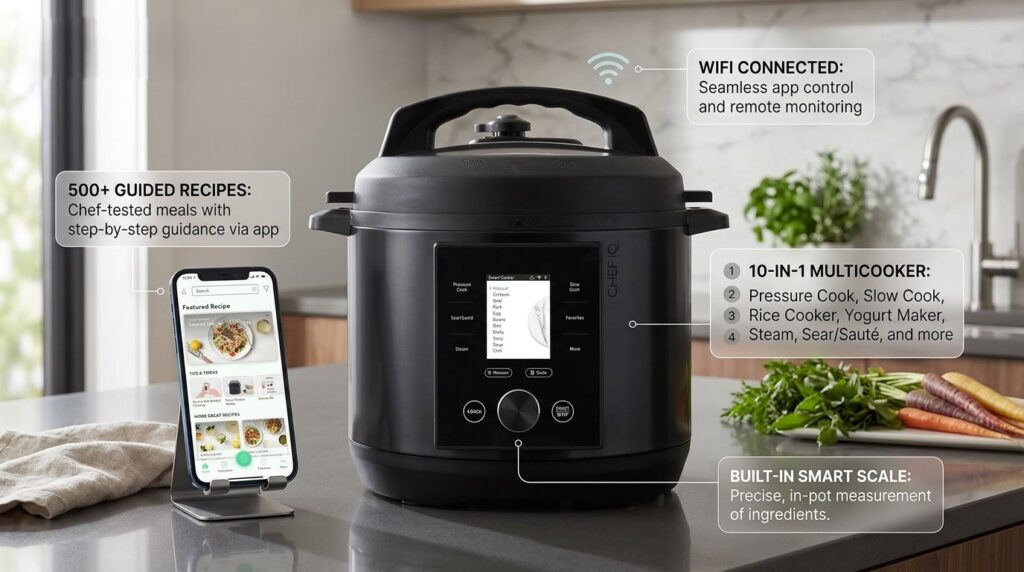
At its core, this is a 6-quart multicooker designed for family-sized meals, built to handle multiple cooking methods in a single unit. It combines the functions typically associated with a pressure cooker, slow cooker, rice cooker, steamer, sauté pan, yogurt maker, and a few other cooking modes into one appliance. What sets it apart from more conventional multicookers is the addition of WiFi connectivity and a built-in scale, both of which are designed to work together through a companion smartphone app.
The scale is a particularly distinctive feature. Instead of measuring ingredients separately before adding them to the pot, the built-in scale allows for weighing directly inside the cooking vessel. This is paired with guided recipes in the app—reportedly numbering in the hundreds—that can adjust cooking instructions based on the actual weight of ingredients added, rather than relying on fixed measurements alone.
Key Features
10-in-1 Functionality
The appliance is marketed as covering ten distinct cooking functions, which typically include pressure cooking, slow cooking, rice cooking, steaming, sautéing, warming, yogurt making, and a few additional presets depending on the specific model configuration. This kind of multi-function design is intended to reduce the number of separate appliances a household might otherwise need, consolidating several tools into a single countertop unit.
Built-In Scale Technology
The integrated scale is designed to measure ingredients directly in the cooking pot, syncing with the companion app to help with portion accuracy. For recipes that rely on precise ratios—certain rice dishes, baked goods adapted for pressure cooking, or recipes involving liquid-to-solid ratios—this feature is intended to reduce some of the guesswork that can come with eyeballing measurements.
WiFi Connectivity and App Integration
Through the associated app, the cooker can reportedly be controlled remotely, allowing users to start, monitor, or adjust cooking programs from a smartphone. The app is also positioned as a recipe hub, with guided instructions that are said to walk users through each step, including automatic adjustments to cooking time or pressure levels based on the ingredients being used.
Guided Recipe Library
One of the more notable aspects of this product is the claimed library of over 500 guided recipes. These are designed to be followed within the app, often with the device itself adjusting settings automatically as the recipe progresses. This is meant to appeal to people who enjoy trying new recipes but don’t necessarily want to spend time researching cook times, pressure settings, or ingredient ratios on their own.
Family-Sized Capacity
At 6 quarts, the cooking pot is sized for family-scale meals, generally suitable for feeding four to six people depending on the dish. This capacity tends to strike a middle ground—large enough for batch cooking or entertaining, while still fitting on most standard kitchen counters.
How It Can Be Used
Multicookers like this one are versatile by design, and the ways people incorporate them into daily cooking routines can vary quite a bit. Here are some general use cases worth considering:
Weeknight meal preparation. Pressure cooking functions are often used to significantly cut down cooking time for dishes that would otherwise take much longer using conventional methods—think stews, tough cuts of meat, or dried beans that haven’t been pre-soaked.
Batch cooking and meal prep. The larger capacity lends itself well to preparing multiple portions at once, which can then be portioned out and stored for the week ahead. This is a common use case among people trying to reduce the amount of daily cooking they need to do.
Rice and grain cooking. As a dedicated rice cooker function, the appliance can handle various grains with more consistency than stovetop methods sometimes allow, particularly for people who cook rice frequently.
Slow-cooked dishes. For recipes that benefit from long, low-temperature cooking—certain soups, braises, or pulled meats—the slow cooker function offers an alternative to the pressure cooking mode, giving more flexibility depending on the dish and available time.
Yogurt making and fermentation-adjacent cooking. Some multicookers, including this one, include settings tailored to yogurt production, which can appeal to those interested in making dairy products at home rather than purchasing them.
Recipe exploration. Given the app-guided recipe library, this device may also serve people who enjoy trying new dishes but prefer structured guidance rather than working from a traditional cookbook or improvising based on experience.
Who It May Be Suitable For
This type of appliance tends to resonate with a fairly specific range of households and cooking styles, though it’s worth noting that suitability always depends on individual kitchen habits and preferences.
Busy families who need to prepare meals efficiently without sacrificing variety may find the multi-function design useful, since it reduces the need to juggle several single-purpose appliances.
People newer to cooking might appreciate the guided recipe system, which is designed to reduce some of the trial and error that can come with learning new techniques, particularly around pressure cooking, which has a steeper learning curve than more familiar methods like sautéing or baking.
Tech-comfortable users who already rely on smart home devices or enjoy app-connected gadgets may find the WiFi functionality a natural extension of how they already interact with their kitchen and home.
Those who cook in bulk for meal prepping, large families, or entertaining purposes may benefit from the 6-quart capacity, which is generally on the larger end for countertop multicookers.
That said, this may be less essential for individuals who cook simple meals infrequently, have limited counter or storage space, or who prefer traditional cooking methods without app dependency. It’s also worth considering that not everyone wants or needs a connected kitchen appliance, and some people simply prefer the tactile simplicity of manual dials and buttons.
Important Things to Consider
Before deciding whether a smart multicooker like this fits your kitchen, there are a few practical considerations worth thinking through.
Counter and Storage Space
Multicookers, particularly ones in the 6-quart range, tend to take up a reasonable amount of counter or cabinet space. It’s worth measuring your available area beforehand, especially if you already own other bulky kitchen appliances.
App Dependency
While the appliance can likely still be operated manually without the app, much of its distinguishing functionality—like the scale-guided recipes and remote monitoring—relies on a stable WiFi connection and a compatible smartphone. Households with inconsistent internet access, or those who prefer not to rely on apps for basic cooking tasks, should factor this into their decision.
Learning Curve
Even with guided instructions, multicookers with numerous functions can take some time to learn, particularly for those unfamiliar with pressure cooking. Understanding safety features, valve settings, and appropriate liquid ratios is generally recommended before diving into more advanced recipes.
Cleaning and Maintenance
As with most multicookers, the inner pot, lid, and sealing components typically require regular cleaning to maintain both hygiene and performance. It’s worth checking whether components are dishwasher-safe and how easily the unit disassembles for cleaning.
Warranty and Customer Support
As with any appliance investment, it’s worth reviewing the manufacturer’s warranty terms and available customer support channels, since these can vary and may affect long-term satisfaction with the product.
Comparing General Categories of Multicookers
To put this appliance in context, it helps to understand the broader landscape of multicookers available on the market today, without singling out specific competing brands.
Basic pressure cookers typically offer straightforward pressure cooking functionality with a handful of presets, minimal digital interface, and no app connectivity. These tend to be simpler to learn but offer less flexibility and guidance.
Standard multicookers expand on this by offering several cooking modes—slow cooking, rice cooking, sautéing—within one unit, but usually without smart features or built-in scales. This category represents a middle ground in terms of both functionality and complexity.
Smart, connected multicookers, the category this CHEF iQ model falls into, add app integration, guided recipes, and in some cases additional sensors like scales or temperature probes. These tend to offer more precision and convenience but come with added complexity, a reliance on connectivity, and often a higher price point compared to more basic models.
Each category serves different needs. Someone who cooks the same handful of dishes repeatedly may not need the guided recipe ecosystem that smart multicookers offer, while someone who enjoys culinary exploration or wants more consistency across different recipes might find real value in that added layer of technology.
Frequently Asked Questions
Does this multicooker require WiFi to function? While core cooking functions can generally be operated manually using the device’s physical controls, many of its standout features—like guided recipes and remote monitoring—depend on a WiFi connection and the companion app.
Is the built-in scale accurate enough for baking? The scale is designed to assist with ingredient measurement for guided recipes within the app. For highly precise baking applications outside the app’s ecosystem, it may still be worth using a separate kitchen scale, depending on your specific needs.
Can this replace multiple separate kitchen appliances? It’s designed to consolidate several functions—including pressure cooking, slow cooking, rice cooking, and steaming—into one unit, which may reduce the need for separate dedicated appliances for some households.
Is it suitable for cooking for a large family? At 6 quarts, the pot capacity is generally suited to family-sized meals, typically accommodating four to six servings depending on the specific recipe.
Are the guided recipes customizable? The app-based recipes are generally designed to guide users through preset instructions, though the extent of customization can vary and is worth exploring directly within the app.
How difficult is it to clean? Most multicookers in this category feature a removable inner pot and lid components that can be cleaned separately. Checking dishwasher compatibility for individual parts is generally recommended.
Final Thoughts
The CHEF iQ Smart Pressure Cooker represents a fairly clear example of where kitchen technology has been heading in recent years—toward greater connectivity, more precise measurement tools, and guided cooking experiences that aim to reduce guesswork. Its combination of a 10-in-1 function set, built-in scale, and extensive recipe library positions it as a tool geared toward people who want both convenience and a bit of culinary guidance built into their everyday cooking routine.
Whether this particular appliance makes sense for your kitchen really depends on your cooking habits, how much you value app-based guidance, and whether the added functionality aligns with how often and how variably you cook. For some households, it could meaningfully simplify meal preparation and reduce reliance on multiple separate appliances. For others who prefer simpler, more manual cooking tools, a more basic multicooker or standalone pressure cooker might be a better fit.